Life x Work: Seeking to Understand, not Persuade
The holidays bring our families and our viewpoints together. This can be joyous or contentious. Here are some work techniques to make your life easier in that moment when you’re not sure how to react.
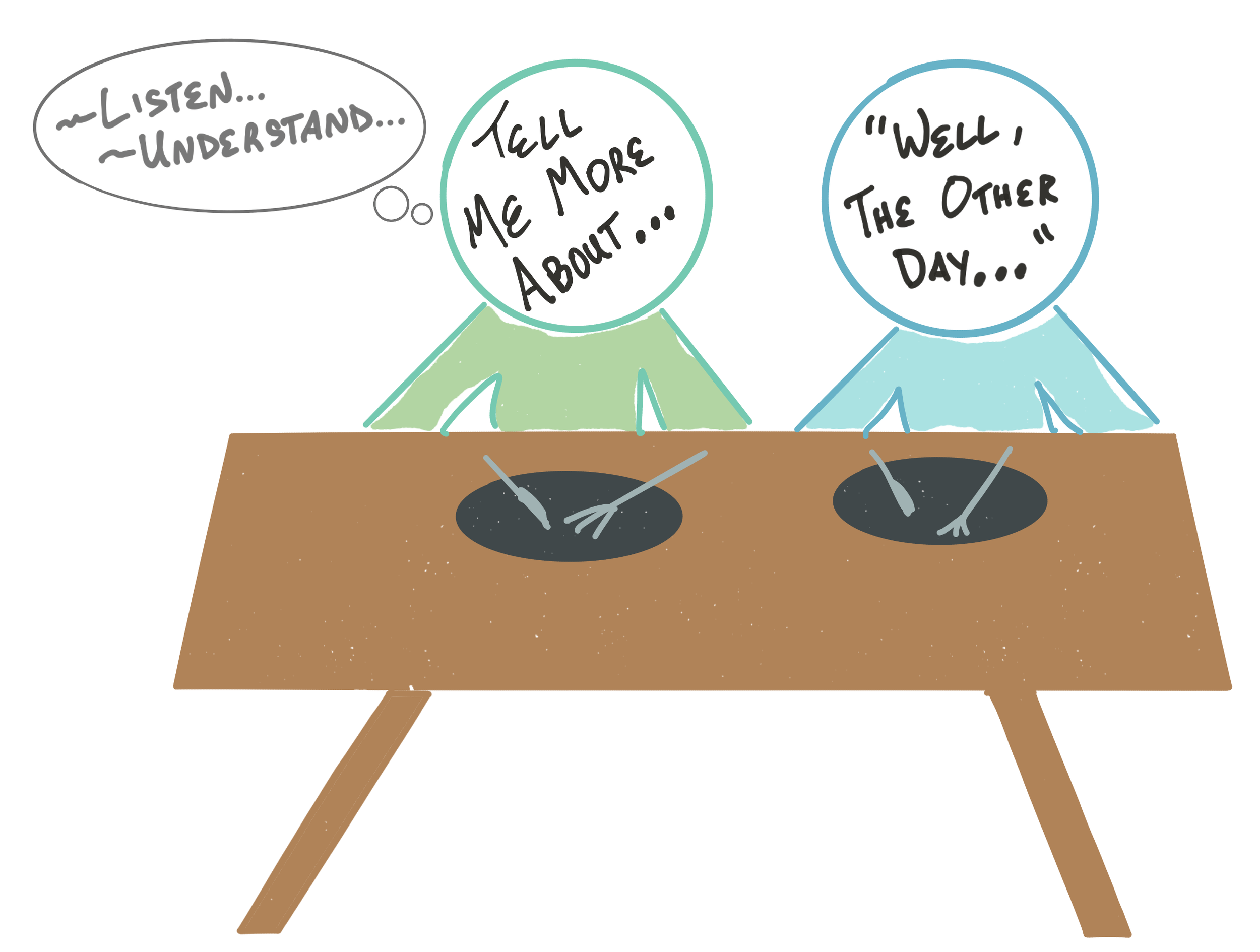
“Tell me more about that…”
During user interviews, we strictly avoid talking about ourselves in order to avoid biasing the interviewee. The technique of encouraging the other person to go deeper into a topic can work in life situations.
When your second cousin (how is that calculated anyhow?) sits down next to you and opens up the conversation, instead of connecting to one of their points and redirecting back to yourself…ask a follow up question.
“Tell me more about…<insert something that you heard from your cousin>”
Our natural instinct is to connect with something the other person is saying. Then we show that connection by talking about ourselves…about how we did that last summer and it was so great and so on and so forth.
In the worst cases, this is hijacking the conversation. If you do this regularly, you might even be considered a “topper.” In more mild cases of redirecting, this comes across as “more about you than about them.”
“Why?”
Somewhere in history, a three-year old invented the “5 Whys” interviewing technique to learn more about people. Ok, not a three-year-old, but asking “Why?” five times can get pretty annoying. You need to be savvy and patient to do this and most of us aren’t.
But even one “Why” can set someone off. Instead of a blunt “Why do you think that?”, try something softer like, “Help me understand how you came to that view,” or “What experiences led you to see it that way?”
When you hear the answer, RESIST the temptation to correct the person, improve on their point or start arguing a counter point. Tell yourself, “I’m in understanding mode, not debate mode.”
Your goal in these conversations is to understand, not persuade.
Our divisions at the family level and the country level can only be bridged if we begin to understand why folks believe what they believe.
When in doubt, collect a story
We collect stories about our users during interviews to understand how they came to experience a certain problem or solution that we’re interested in.
If you foresee a complicated conversation coming up, perhaps you can diffuse the situation by collecting a story.
People enjoy talking about themselves and often enjoy recounting a funny story or meaningful moment.
I have 25 first cousins so even remembering everyone’s names is challenging. But every time I ask about our grandparents or some important location in our family history, I hear a great story.
Or try these:
“How did you meet your partner/spouse/husband/wife?”
“What made you decide to move to ______?”
“If I visited your hometown, where would you take me first?”
“What’s one of your favorite ‘everything went wrong’ stories?”
“What’s a trip or adventure you still think about?”
“What are you most excited about these days?“
Oh, and instead of “What do you do for work?,” you can ask:
“What are you working on these days?” (it lets the other person choose what they want to talk about)
These stories help us get to know each other better and avoid getting into needless arguments.
Concepts that WON’T work
Getting in a word edge-wise
At some point, your conversational skills may become so good that the person you’re talking to completely forgets to ask you a question at all.
This is fine during a work interview but you may feel a bit frustrated at being ignored.
Instead, focus on the positive of giving someone else the chance to express themselves.
However, if it goes on and on, you may need a break.
To get out of the conversation or switch topics, try one of the following:
“I need to go help with [kids / dishes / prep], but I’m glad we got to talk.”
“I need to use the restroom [then get distracted along the way back]”
“Thank you for sharing all that. On a totally different note, can I change gears for a sec?”
Question reflection
One of our favorite techniques during interviews is to avoid answering direct questions from the interviewee. Instead, we ask the interviewee to answer their own question.
You can imagine in regular conversation how rude this would be…”How is your mom doing?”…and you respond with…”How do you think she is doing?”
Nope, don’t do it. Good for interviews. Bad for conversation.
Being a Better Product Manager

Jim coaches Product Management organizations in startups, growth stage companies and Fortune 100s.
He's a Silicon Valley founder with over two decades of experience including an IPO ($450 million) and a buyout ($168 million). These days, he coaches Product leaders and teams to find product-market fit and accelerate growth across a variety of industries and business models.
Jim graduated from Stanford University with a BS in Computer Science and currently lectures at University of California, Berkeley in Product Management.